Posts
Marketing Myopia & Media Research
As India’s traditional audience measurement systems face uncertainty, marketers risk outsourcing their most strategic asset: consumer understanding, Ashoke Agarrwal.
july 9, 2026 1:42pm
Abstract: Theodore Levitt warned marketers against defining their businesses too narrowly. Six decades later, a new form of Marketing Myopia has emerged-not in products or brands, but in media research. As India’s traditional audience measurement systems face uncertainty and digital platforms increasingly measure themselves, marketers risk outsourcing their most strategic asset: consumer understanding. This column argues that marketing now needs measurement sovereignty—independent, cross-media research funded by brands themselves—to ensure that the age of AI is built on objective knowledge rather than platform-defined realities.
Ashoke Agarrwal
In 1960, Theodore Levitt published what is arguably the most influential article ever written on marketing. His Harvard Business Review essay, Marketing Myopia, argued that companies rarely fail because markets disappear. They fail because they define themselves too narrowly. American railroad companies believed they were in the railroad business rather than the transportation business. As automobiles and airlines transformed mobility, the railroads watched their markets shrink while remaining convinced that somebody else’s industry was changing.
More than six decades later, Levitt’s warning continues to echo through boardrooms. Only the forms of myopia have changed.
The first was product myopia: mistaking a product for the customer need it served. Kodak believed it was in the film business rather than the memory business. Blockbuster believed it rented video cassettes rather than delivering entertainment. Their decline has become part of management folklore.
The second has unfolded over the past decade. Seduced by the precision of digital metrics, many marketers began confusing performance with brand building. Clicks, conversions and attribution became ends in themselves, while the slower and less immediately measurable task of creating enduring brand equity was pushed aside. Fortunately, the pendulum is beginning to swing back. Increasingly, marketers recognise that the empty calories of clicks cannot substitute for the long-term nourishment of brands.
There is, however, a third form of marketing myopia that receives surprisingly little attention. It concerns media research. For almost half a century, marketers have outsourced one of their most strategic capabilities: the measurement of audiences and media consumption—to an ecosystem funded largely by others.
The origins lie in the age of mass media. Advertising agencies, remunerated through the familiar 15 per cent commission on media spending, possessed both the resources and the commercial incentive to invest in media research. Publishers, broadcasters and agencies jointly funded audience measurement because all depended upon a trusted trading currency. Brand managers became accustomed to receiving media research almost as a public utility.
It appeared to be a free lunch. It never was. Those funding media research inevitably brought their own commercial interests to the enterprise. Yet because the system broadly worked, few marketers questioned its underlying economics.
India’s Indian Readership Survey (IRS) was perhaps the finest illustration of both the strengths and the weaknesses of this arrangement. While popularly perceived as a newspaper readership study, the IRS evolved into one of the world’s largest single- source consumer databases, providing marketers with an integrated map of readership, demographics, product ownership, lifestyle and media behaviour. For decades it quietly underpinned market sizing, segmentation, distribution planning and media strategy across virtually every major consumer category.
Then, following the pandemic, it stopped. Disagreements among stakeholders over methodology, governance, funding and competitive consequences have delayed its return. Meanwhile, newspapers continue to lose circulation under relentless digital pressure, making an agreed measurement currency even more important than before.
What is remarkable is not that the IRS disappeared. It is that marketers largely watched from the sidelines. One might reasonably have expected India’s largest advertisers—the companies whose billions of rupees in marketing expenditure ultimately depend upon understanding consumers—to have demanded its immediate restoration. Instead, the debate has remained largely confined to publishers, agencies and research organisations.
A similar uncertainty hangs over another pillar of India’s media measurement infrastructure—BARC. As television, connected TV, streaming and online video steadily converge, audience measurement has become simultaneously more important and more complicated. Governance debates, commercial tensions and regulatory scrutiny have left the industry’s principal television currency navigating an uncertain future precisely when advertisers require a more integrated understanding of video consumption rather than a fragmented one.
Again, marketers appear content to watch. Why? Perhaps because they are captivated by the apparent precision of digital media. Perhaps because they believe
qualitative judgement is sufficient when evaluating newspapers or television. Perhaps because the 2011 Census, the last IRS and a generous sprinkling of projections are considered adequate for market planning. Or perhaps because the newest form of marketing myopia has quietly taken hold.
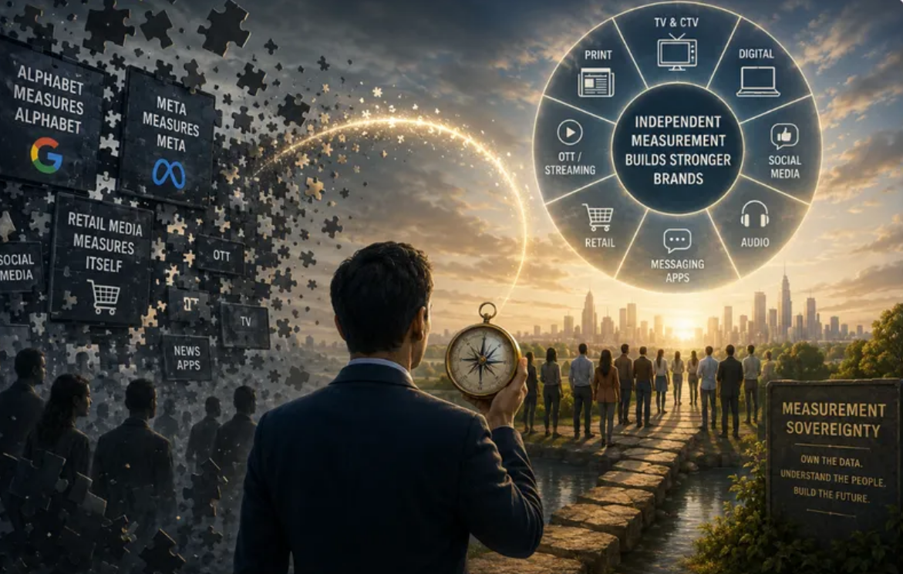
Today’s marketers increasingly rely upon measurement systems owned by the very platforms selling them advertising. Alphabet measures Alphabet. Meta measures Meta. Retail media networks increasingly measure themselves. Every platform offers dashboards, attribution models and sophisticated analytics. Every platform demonstrates impressive returns within its own ecosystem.
Yet consumers do not inhabit ecosystems. They inhabit lives. They move effortlessly from Instagram to newspapers, from YouTube to television, from OTT platforms to search, from retail stores to messaging apps. Brands are built across that entire journey, not within the boundaries of individual media platforms.
No media owner, however sophisticated, can provide an independent view of that journey. Only independent measurement can. Which brings us to an idea whose time may finally have arrived.
Marketing needs measurement sovereignty. Over the past few years we have become familiar with discussions around digital sovereignty, AI sovereignty and data sovereignty. Nations increasingly recognise that strategic capabilities cannot be entirely outsourced if long-term competitiveness is to be preserved.
The same principle applies to marketing. Brands routinely invest enormous sums in advertising, CRM systems, AI tools, influencers, marketing automation and martech stacks. Yet many remain reluctant to invest collectively in the one strategic infrastructure that determines whether all those investments are actually creating awareness, consideration, preference and purchase.
Consumer understanding has become too important to be left entirely to media owners, agencies or digital platforms. Encouragingly, industry bodies around the world are beginning to discuss precisely this challenge. Traditional research companies, technology firms and innovative start-ups are developing new single- source measurement systems that combine passive technology, privacy-preserving techniques and AI to create a continuous picture of media consumption across television, streaming, social media, digital platforms, print, audio and other touchpoints. Their ambition is not merely to count exposures but to connect them to changes in brand equity and commercial outcomes while minimising compliance burdens on consumers.
Such systems represent the future of media research. But they will not emerge simply because technology makes them possible. They will emerge only when marketers recognise them as strategic infrastructure rather than somebody else’s responsibility.
Theodore Levitt taught us that companies fail when they define their business too narrowly. Perhaps today’s marketers suffer from a different kind of myopia. They continue to think that their business is buying media. It is not. Their business is understanding people. Media plans, creative campaigns, AI models and marketing technologies are merely instruments. Consumer understanding is the strategic asset from which they all derive their value.
That is why marketing now needs something more than better research. It needs measurement sovereignty—the ability of brands, acting individually or collectively, to own and govern the independent systems that measure how consumers actually live across media, and how those experiences shape awareness, consideration, preference and purchase. For decades, marketers outsourced that responsibility to agencies and media owners. Today, many risk outsourcing it to digital platforms and algorithms. Neither model serves the long-term interests of brands.
As artificial intelligence reshapes marketing over the coming decade, independent measurement will become even more valuable. AI can optimise only what it is allowed to see. If marketers do not own the knowledge infrastructure that feeds these systems, they will merely automate someone else’s understanding of the consumer. Marketing history teaches the same lesson again and again. Companies rarely lose because technology changes. They lose because they misunderstand what they must own. Yesterday, it was transportation instead of railroads. Today, it is consumer understanding instead of media. Everything else is merely another form of marketing myopia.
Leave a Reply